
"The best way to predict the future is to create it." — Peter Drucker
In his latest article, Sam Altman, the pivotal figure behind OpenAI, introduces us to "GPT-4o" and highlights a promising vision of how artificial intelligence can reshape our interactions with technology. Altman’s insights not only reflect his deep understanding of AI's trajectory but also his commitment to democratizing access to powerful tools. As I delve into his reflections, I find myself captivated by the intersection of innovation, accessibility, and human experience that he articulates.
The Mission of Accessibility
One of the core themes of Altman’s message is the desire to make capable AI tools accessible to everyone—a mission that resonates strongly in today's tech landscape. "I am very proud that we’ve made the best model in the world available for free in ChatGPT," he states, illuminating a principle that has guided OpenAI from its inception. Altman emphasizes that while the organization must operate as a business, the overarching goal is to ensure that significant advancements in AI benefit billions of people.
This approach encapsulates a profound commitment to equity in technology. By prioritizing accessibility, OpenAI ensures that the benefits of AI are not confined to a privileged few. Instead, they manifest as tools that foster creativity, enhance productivity, and potentially elevate the quality of life for a diverse global audience. In a world often divided by disparities in access to technology, Altman’s vision stands as a promising beacon of inclusivity.
A Paradigm Shift in Human-Computer Interaction
Altman’s excitement about the newly introduced voice and video modes in GPT-4o is palpable. He describes it as the best computer interface he has ever experienced, likening it to "AI from the movies." This analogy aptly captures how transformative the interaction feels. For many of us, communicating with computers has typically involved rigid, mechanical exchanges. However, with the advancements spotlighted in Altman’s post, that paradigm is shifting dramatically.
The new interface offers visceral responses and expressiveness, marking a turning point in human-computer interactions. As he notes, "Talking to a computer has never felt really natural for me; now it does." This statement succinctly captures the profound change in user experience that technology can bring. Aligned with user expectations, this intuitive interface stands to revolutionize how we engage with digital tools, encouraging deeper interaction and increasing utility.
The Future of Personalization and Agency
The implications of GPT-4o extend beyond improved interaction; Altman hints at an exciting future where technology becomes a partner in our personal and professional lives. He mentions the addition of personalization, empowering users to instruct AI to take actions on their behalf. This forward-thinking feature has the potential to tailor responses and services to individual needs, amplifying the relevancy and utility of AI in everyday life.
Reflecting on this, I realize this transition towards personalized AI mirrors broader societal shifts toward individual agency. As people, we seek solutions that understand our unique circumstances and preferences, enabling us to leverage technology not just as a tool, but as an enabler of our aspirations. Altman's vision captures this sentiment beautifully, reinforcing the idea that the relationship between humans and machines can be symbiotic rather than transactional.
Grateful for the Innovators
Altman graciously ends his article by acknowledging the team behind GPT-4o: “huge thanks to the team that poured so much work into making this happen!” This sentiment is not only a testament to collaborative effort but also serves as an important reminder of the people who labor behind the scenes to bring innovative concepts to life. Technology can sometimes seem faceless and impersonal, but recognizing the hard work and creativity of the individuals involved is essential. The achievements of OpenAI would not be possible without a dedicated team of thinkers, engineers, and dreamers.
Conclusion: Embracing the Future
Sam Altman's "GPT-4o" isn’t just about technological improvements; it encapsulates a philosophy that values accessibility, creativity, and human connection. His reflections challenge us to consider the profound balance between embracing innovation and ensuring it serves the collective good. By democratizing access to AI tools and advocating for seamless human-computer interactions, Altman and his team are not just shaping a product but paving the way for a more inclusive, innovative future.
As we witness these advancements unfold, I find renewed hope in the possibilities of technology. It's not just about what AI can do, but how it can empower us to be more creative, more productive, and ultimately, more human. The journey ahead promises to be as exciting as it is transformative, and I am both eager and curious to see how we will navigate this new landscape together.
“In the end, the people who are crazy enough to think they can change the world are the ones who do.” — Steve Jobs
As we embrace the vision laid out by Sam Altman, may we all become active participants in this unfolding narrative of innovation and discovery.
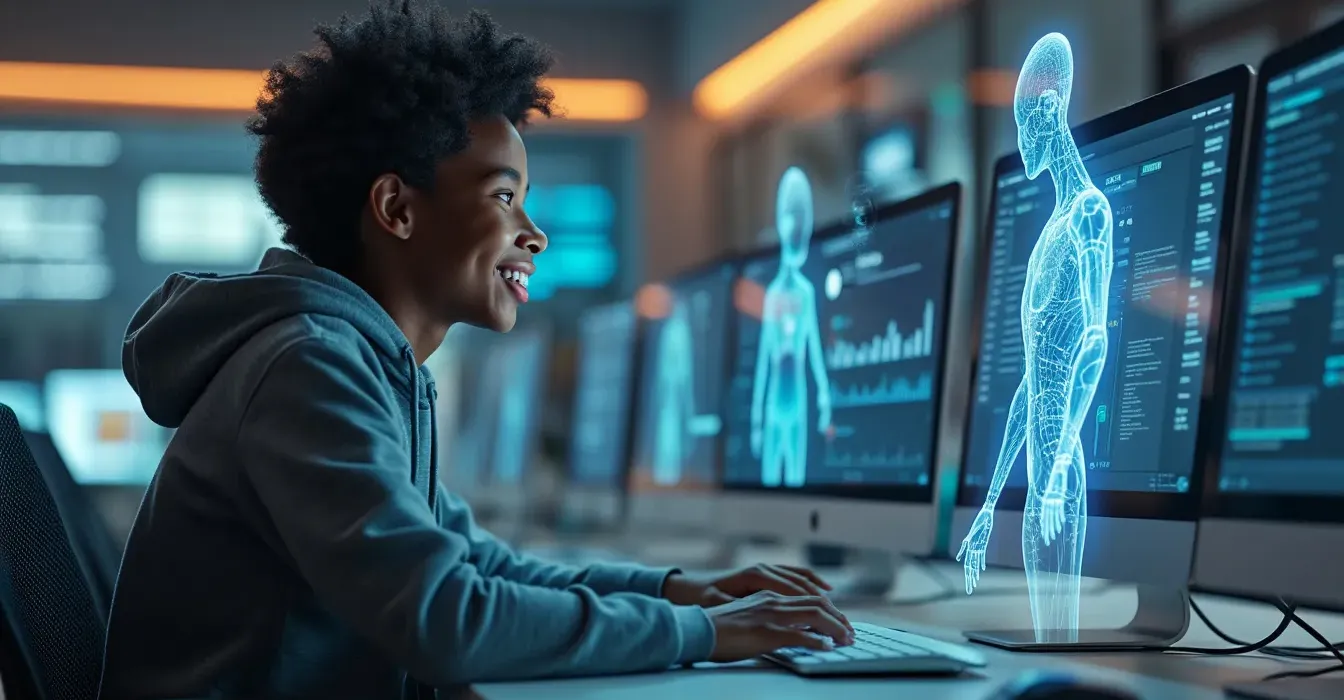
Midjourney prompt for the cover image: A futuristic scene depicting a human interacting with a friendly, advanced AI interface, showcasing voice and video capabilities. The setting is a modern, tech-savvy space filled with sleek computers, soft glowing lights, and a futuristic ambiance. The human, a young person of diverse descent, appears engaged and curious while speaking with the AI, which manifests as a glowing holographic figure. The mood is optimistic and collaborative, highlighting the evolution of human-computer interaction.