

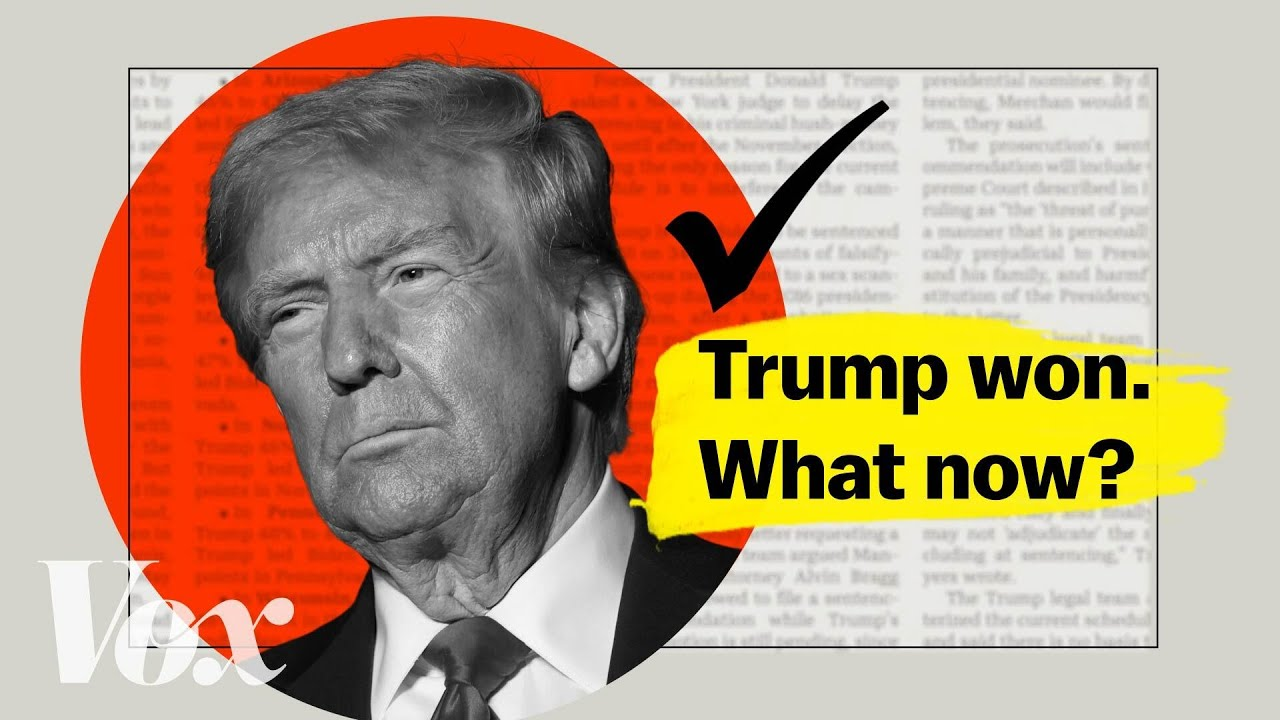
The video explores the re-election of Donald Trump as the 47th president of the United States and the potential implications of his return to office. The analysis dives into how Trump's administration this time around is expected to be different from his previous term, with a more organized approach and a clear set of policy objectives. His new administration is seen as more willing to pursue controversial policies vigorously, with increased support from a more conservative Supreme Court and a Republican-controlled Congress.
Key points discussed include Trump's plans for immigration reform, potentially leading to mass deportations, his influence on Supreme Court rulings, particularly concerning his legal immunity for actions taken in office, and his proposed economic policies, such as imposing tariffs. Additionally, the video highlights Trump's stance on the Israel and Gaza conflict and his intention to alter the civil service system to favor political appointees over nonpartisan career officials.
Main takeaways from the video:
Please remember to turn on the CC button to view the subtitles.
Key Vocabularies and Common Phrases:
1. reactionary [riˈækʃəˌnɛri] - (adjective) - Strongly opposed to social or political reform. - Synonyms: (conservative, right-wing, regressive)
Zach writes about reactionary politics, the right wing, basically.
2. guardrails [ɡɑrd.reɪlz] - (noun) - Systems or measures set in place to prevent undesirable actions or outcomes. - Synonyms: (safeguards, limits, controls)
He was constrained by other parts of the political system, the guardrails of democracy.
3. mantra [ˈmæn.trə] - (noun) - A statement or slogan repeated frequently. - Synonyms: (catchphrase, slogan, motto)
The mantra that Trump had on the border on 2016 was build the wall.
4. outlandish [aʊtˈlændɪʃ] - (adjective) - Looking or sounding bizarre or unfamiliar. - Synonyms: (bizarre, peculiar, strange)
Trump made this really outlandish argument that he could not be charged with the crime for any official acts he committed while president.
5. maximalist [ˈmæksɪməlɪst] - (adjective) - Holding the most extreme or comprehensive view on a certain issue. - Synonyms: (extreme, uncompromising, absolute)
These people have a maximalist vision of what they want the war to be.
6. eviction [ɪˈvɪkʃən] - (noun) - The action of expelling someone from a property. - Synonyms: (expulsion, ejection, removal)
That would mean not just temporary eviction of Gazans from their homes and their cities, which would be bad enough.
7. annex [əˈnɛks] - (verb) - To add or attach, especially to something larger or more important. - Synonyms: (incorporate, add, attach)
Previous American position has been you shall not under any circumstances, annex parts of the West Bank.
8. perpetuity [ˌpɜːpɪˈtwɪɪti] - (noun) - A state of infinite or indefinitely long duration. - Synonyms: (eternity, infinity, permanence)
It would be Israel declaring, in essence, its willingness to rule over the Palestinians in perpetuity.
9. unilateral [ˌjuːnɪˈlætərəl] - (adjective) - Performed by or affecting only one person, group, or country involved in a particular situation, without the agreement of others. - Synonyms: (one-sided, autonomous, independent)
The thing about tariffs is that the president has a lot of unilateral authority to impose them without Congress's will.
10. nonpartisan [nɒnˈpɑːtɪzən] - (adjective) - Not biased or partisan, especially towards any political group. - Synonyms: (impartial, unbiased, neutral)
In any democratic system of government, you need nonpartisan civil servants whose job it is to follow and implement the law.
How Trump’s second term will be different
So I think we should start off by just saying what's happening, and then my big question is going to be, how should we be thinking about this? We now know that Donald Trump is returning to the White House. American voters have seen what Trump had to offer, and at least a critical mass of them decided they want to do the same thing again.
I called up some colleagues at Vox to ask what we should be making of this moment, and I ended up spending a long time talking to Zach. I'm Zach Beacham. I'm a senior correspondent at Vox. Zach writes about reactionary politics, the right wing, basically. And the thing that he really wanted me to understand is that even though the outcome of this election is the same as the 2016 election, the Trump who is about to become president in is different. Donald Trump is much more organized. He knows what he's doing, has a series of distinct policy objectives that he's reiterated again and again. It will be, in a lot of ways, fundamentally different than what we all lived through four years ago.
Lock up the Bible. Lock up Hillary. Block them up. The first time Trump was president, he wanted to do all sorts, sorts of very controversial things, and a lot of times, he didn't actually end up doing them. One big example is wanting his critics and political opponents to be prosecuted. He was constrained by other parts of the political system, the guardrails of democracy.
I'm Andrew Prokop. I cover politics. The guardrails encompass first Congress and the courts, but also within the executive branch, you have Trump's own appointees for top positions who often last time around, proved unwilling to carry out some of the things he wanted to do. Then you also have the permanent civil service career employees that he can't fire at will.
First of all, the courts have grown more conservative and more Trump friendly since he put three of his own appointees in the Supreme Court. Congressional Republicans have grown much more pro Trump. Trump and the people around him want hardcore MAGA true believers staffing the government who will have these pesky qualms about legality or ethics or things like that. And regarding the civil service, Trump wants to use an executive order to reclassify thousands of people with civil service protections against firing as political appointees who he can fire to then put in a lot of MAGA loyalists in their place.
Instead, he's had four years to basically stew over, you know, what he didn't get to do last time and what he would do differently if he was given another chance. And now he will seemingly get that chance. We're going to have the largest deportation in the history of our country. The mantra that Trump had on the border on 2016 was build the wall. That was his centerpiece of his immigration platform. That sort of changed over the course of his presidency, and increasingly he wanted to turn his intention not to the border, but to the interior of the US the undocumented population here.
I'm Nicole Nora and I covered politics and immigration for vox. Under Biden, there were record levels of people arriving on the border. We've seen those numbers come down significantly in 2024. But when Americans are polled, large portions of them say that they want mass deportations. They might be thinking about people being deported immediately after they arrive on the border. But that's not what Trump's contemplating. He's trying to go into communities across the US and we're talking about people who have lived here, you know, for years and decades. That would sort of involve huge investments in law enforcement and also the cooperation of local law enforcement agencies, which I'm not sure we would see necessarily in Democratic states. But let's say in states like Texas and Florida, certainly you might find law enforcement willing to cooperate with federal immigration authorities there.
A landmark decision in American history as it relates to presidential power. When Trump initially took office, the median vote on the Supreme Court was a moderate consensus conservative, someone who would draw the line somewhere. Then Trump appointed a third of the United States Supreme Court. I'm Ian Millhiser. I cover the Supreme Court at vox. Trump v. United States is the decision that came down last July concerning Special Prosecutor Jack Smith's indictment of Trump for trying to steal the 2020 presidential election. Trump made this really outlandish argument that he could not be charged with the crime for any official acts he committed while president. Pretty much everyone thought that that argument was silly and ridiculous, and there was no chance that the court would ever adopt it. And then all six of the Republican justices adopted it.
What that decision said, it said that Donald Trump is immune from criminal prosecution for crimes that he commits using the official powers of office. Trump is allowed to give any order he wants to the Department of Justice. The basic matter is just that anything he does can potentially be beyond the scope of the criminal justice process.
More than 40,000 Palestinians killed since the October 7 Hamas massacre. Right now, the situation on the ground in Gaza is an extraordinary humanitarian crisis and a moral stain on the United States for enabling so much of this to happen. But it can always get worse. Trump has a blank check approach to Israel. He and his advisors don't believe in any of the even feeble restraints that the Biden administration had put on Israeli conduct. There are factions inside the Israeli government that have different visions of how to conduct the war. The extreme right on Netanyahu's flank. People like Bezalel Smotrich and Itamar Ben GVIR believe that Trump will let them do what they want based on what he said, what his advisors say, and what his political coalition at home wants.
Are you on board with the way the IDF is taking the fight to God in Gaza? You've got to finish the problem. These people have a maximalist vision of what they want the war to be. Actually seizing and taking Gaza for Israel and returning to settlement. Right? To rebuilding Israeli outposts, moving Israeli Jewish citizens in to make sure that its control over the area never slips. That would mean not just temporary eviction of Gazans from their homes and their cities, which would be bad enough. It would mean creating a massive permanent refugee population outside of Gaza in the west bank, we can only imagine. Previous American position has been you shall not under any circumstances, annex parts of the West Bank. It would be Israel declaring, in essence, its willingness to rule over the Palestinians in perpetuity. What I do know for sure is that a Trump administration would do nothing to punish them for it.
Trump declared he would veto a national abortion ban if he's reelected. Trump winning the presidency is not good for abortion rights. I mean, he's Been out there claiming that he's the father of ivf, that he's going to be great for women's rights, but he surrounds himself with lots of people who absolutely, you know, do not have that as their goal. I'm Rachel Cohen. I cover social policy at Vox, and I've been really focused on abortion rights for the last two and a half years since Roe was overturned.
Something that has been confusing for voters is that I don't think we're going to see a federal ban coming out of Congress. The biggest way that Trump could, I think, use his executive power to restrict abortion rights is to push for the enforcement of the Comstock act on the federal level. The Comstock act was this law passed in 1873, and among other things, it banned mailing anything associated with abortion. When the Supreme Court legalized abortion nationwide, the Comstock act was rendered moot. It didn't matter anymore. But Congress never actually repealed it. Now that Roe has been overturned, you have a bunch of conservatives, including J.D. vance, who are saying now is the time actually to enforce this zombie law that's been on the books for decades that people forgot about, and we should ban anything associated with abortion from being sent in the mail.
So that could include not only abortion pills, which are used in the majority of abortions in the US but it could also mean any medical equipment associated with, you know, surgical abortion, like dilators or speculums. That would effectively mean a nationwide ban on abortions.
Some might say it's economic nationalism. I call it common sense. The thing about tariffs is that the president has a lot of unilateral authority to impose them without Congress's will. I'm Eric Levitz, and I write about politics and policy. A tariff is basically a tax on an imported good. Usually the producer passes on the cost of that tax to consumers by charging higher prices to compensate for the tax. Trump's signature proposal on tariffs in the 2024 campaign was a 10% tariff on all foreign imports, regardless of what country they come from and regardless of what kind of good it is, which includes things that the United States cannot possibly produce. There's no tax that you can put on foreign coffee beans that will make it possible to grow them in New England.
The general consensus from economists is that this is going to significantly increase prices for Americans, as well as actually potentially undermining American manufacturing. I think that in general, voters tend to be sympathetic to any protectionist trade policy. But I think that in practice, as we've seen in the Biden years, voters are very sensitive to increases in consumer prices. On the other hand, though, this is something that Trump really, genuinely seems to believe and hold as a core economic principle, really, since the late 1980s, we let Japan come in and dump everything right into our markets and everything. It's not free trade. Put a 25% tax on products that come into the United States. So that means that Trump plausibly could enact this tariff, even if a majority of Republicans in Congress do not want him to.
It's time to put the divisions of the past four years behind us. It's time to unite. And we're going to try. We're going to try. We have to try. In any democratic system of government, you need nonpartisan civil servants whose job it is to follow and implement the law. A lot of that stuff is technical, from national parks administration to the way the Defense Department is run, to the way that we protect and store our nuclear weapons. Trump doesn't like this. Neutral rules of governance obstruct his ability to govern like a kind of machine politician who uses government as a tool of rewarding his friends and punishing his enemies.
That's why he hates what he calls the deep state. Demolish the deep state. Obliterate the deep state. Dismantle the deep state. We could be in a world where very swiftly, because there are no legislative guardrails against this. What if the IRS is now a fully political agency and audits are coming in along political lines? Businesses or media organizations that are critical of Trump start being harassed, using the tax code as a means of punishing them. Think about everything that you rely on government to do. And now imagine those tasks being bent towards political ends. Donald Trump is going to be the next president of the United States again. And this time around will make the first time look like child's play.
Politics, American Politics, Leadership, Donald Trump, Immigration, Abortion Rights, Vox