
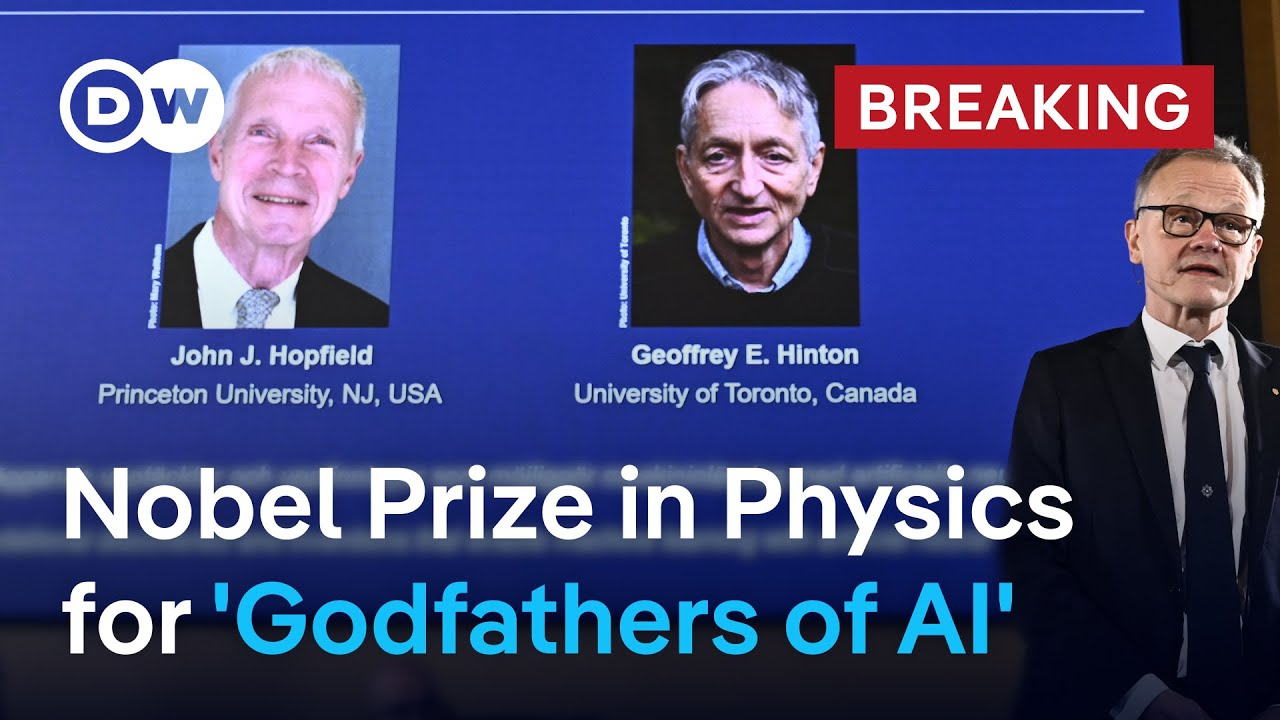
The Nobel Prize in Physics this year was awarded to American John Hopfield and Canadian Geoffrey Hinton for their significant contributions to the field of machine learning. These breakthroughs are seen as fundamental to machine learning's potential in assisting humans with faster and more accurate decision-making, such as in medical diagnostics. However, there are rising ethical concerns regarding AI development, including issues of control over AI technology, which were acknowledged by the Nobel committee.
John Hopfield's notable contribution is the development of the Hopfield Network, a type of neural network that models the brain's neurons with nodes, allowing systems to recall and restore distorted images. Hinton further advanced these models, enabling the creation of complex systems that can produce accurate, descriptive outputs, as seen in applications like ChatGPT. These technological advances underscore the practical implications and potential of AI across various sectors.
Main takeaways from the discussion:
Please remember to turn on the CC button to view the subtitles.
Key Vocabularies and Common Phrases:
1. inventions [ɪnˈvɛnʃənz] - (n.) - Newly created products or processes developed from study and experimentation. - Synonyms: (creations, innovations, developments)
Discoveries and inventions form the building blocks of machine learning that can aid humans in making faster and more reliable decisions.
2. diagnosing [ˌdaɪəɡˈnoʊsɪŋ] - (v.) - The process of identifying a disease or problem by examining someone or something. - Synonyms: (identifying, detecting, determining)
...for instance, when diagnosing medical conditions.
3. misused [ˌmɪsˈjuːzd] - (v.) - To use something in a way that is not intended or appropriate. - Synonyms: (abused, exploited, mishandled)
...the way that it could be misused or the way that it could be spunk out of control.
4. neurons [ˈnjʊərɒnz] - (n.) - Nerve cells responsible for receiving sensory input from the external world. - Synonyms: (nerve cells, brain cells, neurocytes)
...effectively replaces the neurons of our brain with nodes.
5. synapses [ˈsɪnæpsɪz] - (n.) - The junctions between neurons through which signals are transmitted. - Synonyms: (junctions, connections, links)
...In the same way that the neurons of our brain are connected by synapses...
6. astrophysics [ˌæstroʊˈfɪzɪks] - (n.) - The branch of astronomy dealing with the physical properties and phenomena of celestial objects. - Synonyms: (astronomy, cosmology, space physics)
But astrophysics, for example, has benefited from this technology.
7. photovoltaic [ˌfoʊtoʊvɒlˈteɪɪk] - (adj.) - Relating to the technology of converting sunlight into electricity. - Synonyms: (solar, panel-related, PV)
Photovoltaics is an example that was raised by the Nobel committee.
8. interpret [ɪnˈtɜːrprɪt] - (v.) - To explain the meaning of information, words, or actions. - Synonyms: (explain, translate, clarify)
...and trying to interpret what this is seeing for astrophysicists...
9. tumor [ˈtjuːmər] - (n.) - A mass of tissue formed as the result of abnormal cell division. - Synonyms: (growth, lump, neoplasm)
...an image or an x ray and say, there's the tumour, even if to the human eye it might not be so clear.
10. neural network [ˈnjʊərəl ˈnɛtwɜːk] - (n.) - A computer system modeled on the human brain's network of neurons. - Synonyms: (artificial neural system, machine learning model, AI network)
...which ended up carrying his name, the Hopfield Network, which was an interesting little neural network...
John Hopfield, Geoffrey Hinton win Physics Nobel Prize for findings in machine learning | DW News
The winners of this year's Nobel Prize in physics have been announced. American John Hopfield and Canadian Jeffrey Hinton are the recipients of the award for their discoveries and inventions in the field of machine learning. Let's listen to why the Nobel Prize committee shows these particular winners.
Discoveries and inventions form the building blocks of machine learning that can aid humans in making faster and more reliable decisions, for instance, when diagnosing medical conditions. However, while machine learning has enormous benefits, its rapid development has also raised concerns about our future.
I'm now joined by Matthew Ward, ages from TW science. Matthew, we just heard the committee honoring their work. They were at the same time raising concerns. What do they mean? Well, I think the thing that they are pointing to in this case is what we've seen, talked about quite a bit over the last few years, particularly as we've seen large language models, which are a form of artificial intelligence, described and I guess a product of the work that these two gentlemen have done over the years and the way that it could be misused or the way that it could be spunk out of control.
Geoffrey Hinton, the Canadian British winner of this year's award, or joint winner of this award, has raised in the past his concerns about the loss of control of AI technology. So that's the ethical consideration when it comes to it, that was raised by the Nobel committee in announcing this year's winners.
Of course, there are positive aspects to AI, which is the reason why these two individuals have won the award, given the potential and enormous positive outcomes that the adaptation of this technology could have, tell us more about their work that earned them the prize.
So the original work started in the early eighties. Sir John Hopfield developed something which ended up carrying his name, the Hopfield Network, which was an interesting little neural network, which, in layperson's terms, effectively replaces the neurons of our brain with nodes. In the same way that the neurons of our brain are connected by synapses, these nodes are connected to each other. You feed some information in, say, an image, and it's able to store and save and recall that information if it's given a problem later down the track.
And in this case, the Nobel Prize committee described the way that a distorted or incomplete image could be fed into this system and then retrieved by the system, finding from a distorted image the most likely image that you are trying to find from that previously saved information. And then Hinton's work built on this, creating more complex models that could recall information.
So really, we see this today a lot when we put information into chat GPT, for example, and it spins off pretty accurate, often descriptive text that tries to answer that question. But, of course, there are other applications as well.
As I mentioned, let's talk about these other applications. It's not all about AI, right? Well, it is all about AI, but it's what the AI can do for us. So we have seen AI begin to find its way into other branches of science.
This is a physics Nobel prize. This is computational and statistical physics that we've seen recognized. But astrophysics, for example, has benefited from this technology. Being able to understand information that is being read in star systems well beyond our own, and trying to interpret what this is seeing for astrophysicists and astronomers to make sense of materials science, being able to spin up theoretical new materials that we may have use for in the future.
Photovoltaics is an example that was raised by the Nobel committee. We've got standard photovoltaic cells now made from silicon. But what other materials could we invent that might be more efficient at capturing sunlight? And medical imaging as well, is another point that has been raised to feed to an AI model an image or an x ray and say, there's the tumour, even if to the human eye it might not be so clear. So it's the ability to take information that we as humans might not be able to make sense of and make sense of it for us.
Thank you very much. Matthew Aguirre is there from DW science.
Physics, Innovation, Technology, Artificial Intelligence, Machine Learning, Nobel Prize, Dw News