
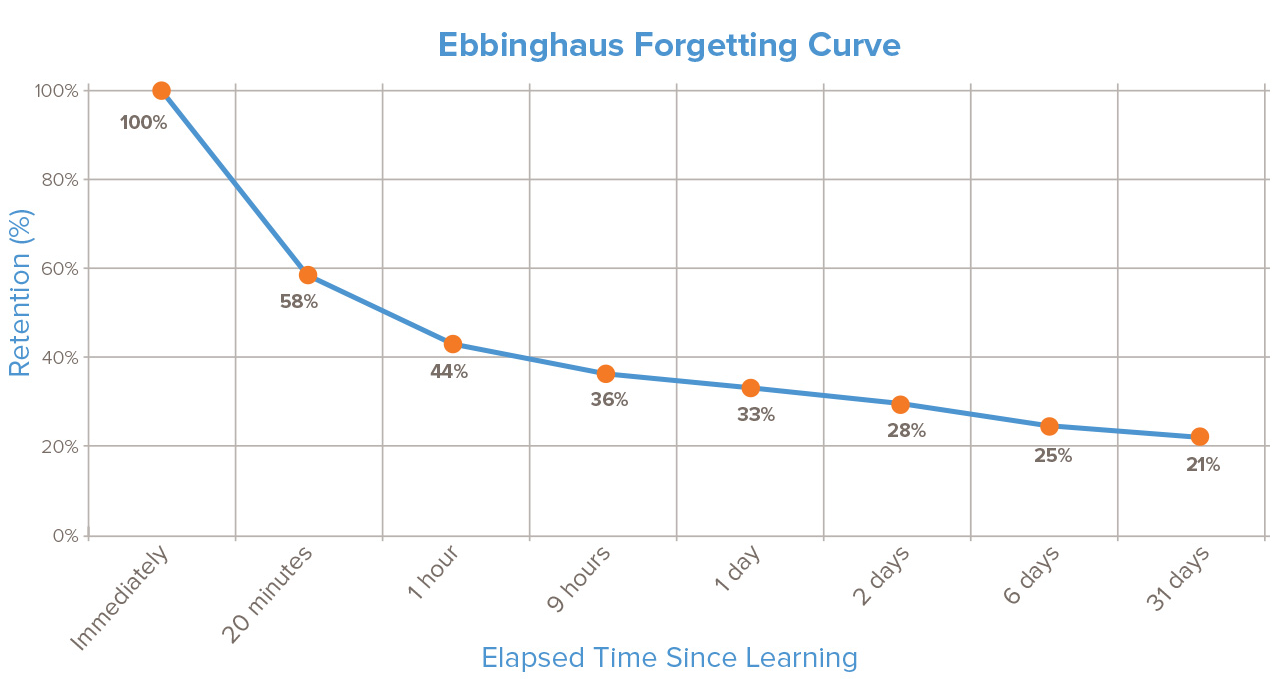
The human brain, despite its incredible capacity, faces a persistent challenge: forgetting. The process of losing information over time, known as forgetting, can be frustrating, particularly when we strive to learn new pieces of information. Understanding the mechanisms of forgetting has significant implications for education, training, and self-directed learning. One of the most notable theories that elucidate the forgetting process is Ebbinghaus's Forgetting Curve. This post will delve into Ebbinghaus's research, the significance of the forgetting curve, and how we can use this knowledge to enhance our learning processes.
Who Was Hermann Ebbinghaus?
Hermann Ebbinghaus was a German psychologist who, in the late 19th century, made pioneering contributions to the study of memory and cognitive psychology. He was one of the first researchers to conduct experimental studies on memory. His methodologies were groundbreaking at the time—Ebbinghaus used systematic and scientific approaches to study how we memorize and forget information.
In his most famous work, “Memory: A Contribution to Experimental Psychology” (1885), Ebbinghaus introduced the concept of the forgetting curve and how it portrays the theoretical decay of memory retention over time.
The Forgetting Curve Explained
Ebbinghaus conducted experiments on himself using nonsense syllables to prevent prior knowledge from skewing the results. He memorized lists of these syllables and then tested his recall over different intervals. The results revealed a distinct pattern: individuals forget information quickly after learning it if no effort is made to retain it.
Ebbinghaus constructed the forgetting curve to visually represent this phenomenon. The curve depicts memory retention over time, showing that:
- Initial Rapid Forgetting: After learning, retention drops sharply within the first hour and continues to decline rapidly over the first few days.
- Gradual Decline: As time progresses, the rate of forgetting slows down, suggesting that some information is retained, albeit not perfectly.
- Potential for Long-Term Memory: With repeated exposure or reinforcement, certain pieces of information can be preserved in long-term memory.
The Graph of Forgetting
To give you a better understanding, let’s visualize the forgetting curve:
Retention Percentage
100%|*
 90%| *
 80%|   *
 70%|     *
 60%|        *
 50%|            *
 40%|                *
 30%|                    *
 20%|                         *
 10%|                              *
   0+---------------------------------------------> Time
In this graph, you can see clearly that retention decreases significantly shortly after the first learning session and continues to do so at a slower pace. This visually illustrates the dramatic effect of time on memory, emphasizing the necessity for strategized learning techniques.
Factors Influencing the Forgetting Curve
While Ebbinghaus's findings offered crucial insights into the forgetting process, several factors influence the curve and how quickly we forget information:
1. Nature of the material
- Familiarity: If you're learning something closely related to previously acquired knowledge, you may find less forgetting. Newly learned languages, for example, often relate to one's native tongue.
- Meaningfulness: Information that carries personal significance tends to be easier to retain than abstract material. The more emotionally charged or relevant the content, the better the memory retention.
2. Methods of learning
- Repetition: Engaging in spaced repetition (reviewing material at increasing intervals) can dramatically improve memory retention.
- Active engagement: Learning methods such as summarization, teaching others, or applying new information can significantly enhance your ability to remember.
3. Emotional Context
Emotions play a significant role in memory retention. Events or pieces of information tied to strong emotions are generally better remembered. This "emotional memory" is due to the activation of the amygdala, which forms connections with different aspects of memory.
4. Frequency and spacing of learning sessions
Spacing out learning sessions, rather than cramming all at once, is key. The spacing effect encourages better long-term retention of learned material.
Practical Applications of the Forgetting Curve
Understanding the forgetting curve offers transformative strategies to enhance learning:
1. Spaced Repetition
The principle of spaced repetition is the most practical application derived from the forgetting curve. This technique involves reviewing material at scheduled intervals:
- Initial Review: Right after learning.
- Subsequent Reviews: After one day, one week, one month, etc.
This helps combat the rapid decay of memory observed shortly after learning.
2. Active Recall
Instead of passive study methods such as rereading, active recall involves actively testing oneself on the material. Here are some methods to incorporate:
- Flashcards: Write down questions on one side and answers on the other to test yourself.
- Quizzes: Create or use pre-existing quizzes to stimulate memory engagement.
- Teaching: Explaining the material to someone else can reinforce your understanding and memory.
3. Interleaved Practice
Rather than focusing on one subject or skill at a time, interleave different subjects. This method promotes problem-solving skills and long-term retention as you shift attention between topics.
4. Visualization Techniques
Employ techniques such as mind mapping or visualization to create mental images of what you are learning, enhancing retention through associative memory.
5. Utilizing Mnemonic Devices
Mnemonic devices, including acronyms and rhymes, can provide mental shortcuts to help us memorize information more efficiently.
Overcoming Forgetting in Education and Professional Development
Within educational systems and professional settings, understanding the forgetting curve can inspire tools and methodologies that foster a culture of effective learning.
1. Incorporating Feedback Loops
Regular feedback allows learners to assess their comprehension and fill gaps, thus minimizing forgetting through timely reviews.
2. Assessment and Reflection
Encouraging reflection after assessments can reinforce the material learned and mitigate the effects of forgetting. Promoting reflective learning practices can enhance retention over time.
3. Creating a Supportive Learning Environment
A favorable learning atmosphere can cultivate intrinsic motivation, enhancing emotional connections with material, leading to better memory retention.
Conclusion: Mastering Memory for Life
Ebbinghaus’s forgetting curve presents an essential perspective on the dynamics of memory and forgetting. With understanding comes the power to enhance how we learn, retain, and recall information effectively. While forgetting is a natural process, employing strategic learning methods can transform the landscape of memory retention.
Call to Action
Are you ready to take charge of your learning journey? Consider implementing spaced repetition and active recall in your study routine. By applying these techniques, you’ll harness the power of Ebbinghaus’s forgetting curve and retain more information, fostering a lifelong love of learning. Explore, experiment, and discover what methods work best for you. Share your experiences in the comments below!
 Leo Wang
 Leo Wang
 Chief Editor
 Chief Editor